

Jakarta –
China is preparing to use humanoid robots in patrol operations at key border posts with Vietnam. This is a major step in the application of artificial intelligence (AI) in the country’s security infrastructure.
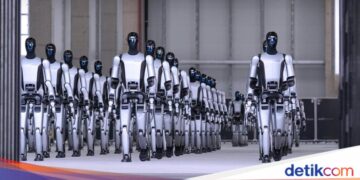
The robot that will be installed at the Fangchenggang border crossing in the Guangxi region was developed by UBTech Robotics and is known as the Walker S2 model. With a contract worth around 264 million yuan (around Rp. 643 billion), the robot will not completely replace human officers, but is designed to help with tasks such as crowd guidance, inspections and logistics support.
The Walker S2 model also attracted attention for its ability to replace the battery automatically, enabling nearly 24 hours of non-stop operation. These capabilities demonstrate China’s ambition to transform humanoid robots from prototypes into reliable infrastructure systems in public and industrial environments.
SCROLL TO CONTINUE WITH CONTENT
The robot implementation is seen as a major trial in the use of robots in high-traffic environments, where the flow of visitors, buses and trucks must be processed without interruption. If successful, similar technology could be extended to airports, ports or train stations.
These robots are prepared to support border officers in several functions, including guiding queues of travelers, managing vehicles, and answering basic questions from travelers. Several units will also carry out patrols in corridors and waiting areas to monitor conditions or potential disturbances.
Although this project is taking place in Asia, the same idea is also starting to gain traction in Europe, especially amidst increasing migration pressures. According to the Hungarian Government Commissioner for Artificial Intelligence, László Palkovics, humanoid robot technology has now reached the point where mass production is realistic.
He explained that this technology has passed the experimental phase and is ready for mass production, especially with the involvement of the strong automotive sector in Hungary. “This technology has now passed the experimental phase and is ready for mass production,” said Palkovics, quoted by the Hungarian Conservative, Monday (16/2/2026).
Emulating China, the European Union’s border guard agency, Frontex, has used a variety of technologies to strengthen AI-based automated border surveillance and control, and humanoid robots could be the next step in that evolution.
“Humanoid patrol robots could be the next step in Europe’s gradual shift towards AI-powered automated border controls,” analysts wrote in a report.
(rns/hps)